What is disaster resilience?
While natural hazards are inevitable, their impact on human and economic losses and on the number of people affected can be limited by building resilience to disasters.
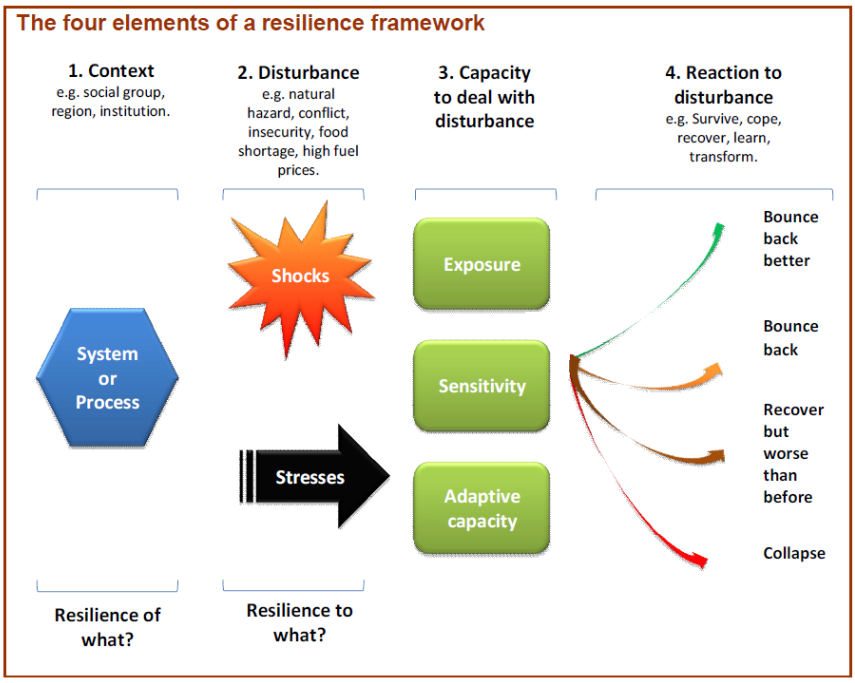
Key definitions (OECD) adapted to the context of natural-hazard related disasters Resilience: the ability of families, communities and nations to absorb and recover from shocks emanating from slow and rapid onset disasters, whilst positively adapting and transforming their structures and means for living in the face of future shocks, long-term stresses, change and uncertainty. Resilience can be boosted by strengthening three different types of capacities: Absorptive capacity: The ability of a system to prepare for, mitigate or prevent negative impacts, using predetermined coping responses in order to preserve and restore essential basic structures and functions. This includes coping mechanisms used during periods of shock. Examples of positive absorptive capacity include clear roles and responsibilities during emergency response at all levels, access to insurance against disasters, construction of basic infrastructures a safe zones. Adaptive capacity: The ability of a system to adjust, modify or change its characteristics and actions to moderate potential future damage and to take advantage of opportunities, so that it can continue to function without major qualitative changes in function or structural identity. Examples of adaptive capacity include diversification of livelihoods, development of early warning systems for floods, involvement of the private sector in delivering basic services, and introducing drought resistant seed. Transformative capacity: The ability to create a fundamentally new system so that the shock will no longer have any impact. This can be necessary when ecological, economic or social structures make the existing system untenable. Examples of transformative capacity include knowing risks and implement land use plan accordingly, seismic resistant building code in place and respected. |
Disaster resilience mechanisms
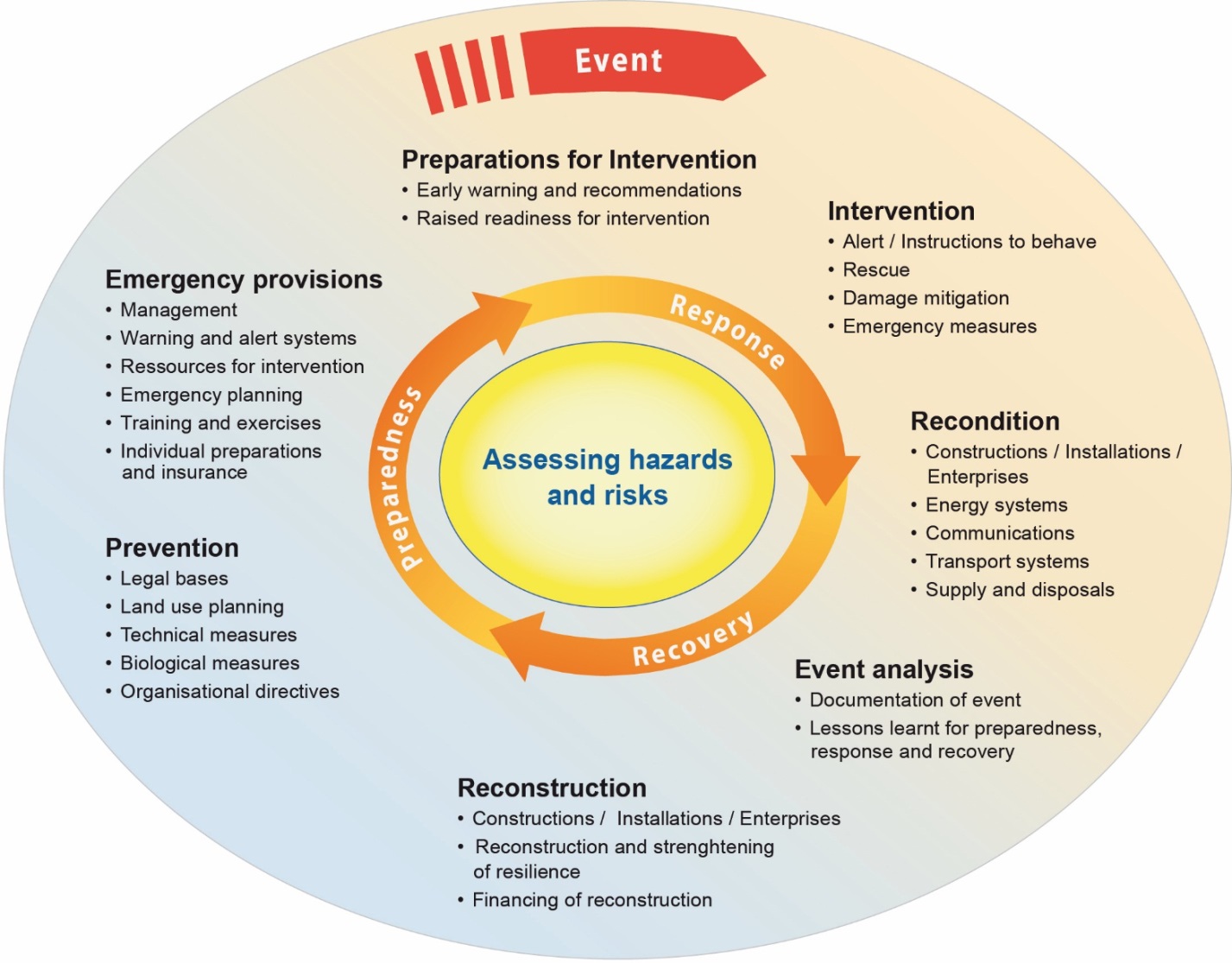
The various mechanisms exist to reduce risks: prevention (avoid hazards and hazardous zones); mitigation (reduce effects of hazard or reduce vulnerability of element at risk); preparedness and response (get prepared and respond to damage); recovery (transfer risks for rehabilitation and reconstruction). The reduction of risks depends on the mix of measures. Residual risks have to be carried by the individual.
SDC promotes the approach of integrated risk management to build resilience: instead of dealing with each stage of the disaster cycle independently, preventing disasters can be a part of all stages of disaster management.
Find out more about SDC’s expertise in integrated risk management:
Prevention and mitigation
Preparedness and response
Recovery and reconstruction
Risk transfer and sharing
Maintreaming on disaster resilience in SDC's interventions
Support to the international disaster resilience system
What is Resilience?
Resilience is the ability of households, communities and nations to absorb and recover from shocks, whilst positively adapating and transfomring their structures and means for living in the face of long-term stresses, change and uncertainty. (Mitchel, 2013)
Disaster resilience has also been described as both an outcome and a process.
Based on its previous work, SDC has developed its concept on disaster resilience and disaster risk reduction both advocated through its policy dialoge at the global level and at the grass roots through implementation of programmes together with key partners.
The world is facing an unprecedented scale of disasters. The number of reported natural disasters including droughts, floods, windstorms and earthquakes has tripled in the past few decades. Over the same period, the number of affected persons has been even greater due to the following reasons:
- Demographic pressure leading to rapid urbanization, use of marginal grounds, and unplanned settlements, increasing people's vulnerability and exposure to natural hazards.
- Factors related to climate change, linked to more frequent and more intense natural processes and extreme weather events, such as droughts, storms and heavy rainfall. The number of disasters will augment as global warming generates more severe weather-related events.
- Environmental degradation caused by the over-exploitation of natural resources, such as deforestation, leading to an increase in disaster risks.
Disasters arise when an extreme natural or technological events coincides with lives and human activity. Even if natural hazards cannot be fully avoided, risk factors can be reduced and mitigated to a large extent. Disaster risk reduction (DRR) aims to:
- reducing existing risks (vulnerability and hazards),
- adapting to changing risk factors (e.g. climate change),
- anticipating and preventing new risks via risk-conscious development (do no harm principle).
 |
Resilience Resilience is defined by the scientific community (Resilience Alliance) but this remains quite abstract for a practitioner, however a few principles can be a good way to understand resilience: - Buffer capacity or robustness (capacity to absorb stress, hazard, disturbance or destructive forces, maintain certain basic functions and structures during disastrous events)
- Capacity for learning, adaptation and self-organization (which includes improving or 'bouncing forward' after an event)
A focus on resilience means putting greater emphasis on what communities can do for themselves and how to strengthen their capacities, rather than concentrating on their vulnerability to disaster or their needs in an emergency. Resilience is nested within larger systems, which means that e.g. communities resilience depend on capacities outside the community and a web of socio-economic and political linkages with the wider world (Twigg 2007). |
Sendai Framework for Disaster Risk Reduction 2015-2030 On 18 March 2015, in Sendai, Japan representatives from 187 UN member States adopted the first major agreement of the Post-2015 development agenda, a far reaching new framework for disaster risk reduction with seven targets and four priorities for action.
The framework outlines seven global targets to be achieved over the next 15 years: a substantial reduction in global disaster mortality; a substantial reduction in numbers of affected people; a reduction in economic losses in relation to global GDP; substantial reduction in disaster damage to critical infrastructure and disruption of basic services, including health and education facilities; an increase in the number of countries with national and local disaster risk reduction strategies by s with national and local disaster risk reduction strategies by 2020; enhanced international cooperation; and increased access to multi-hazard early warning systems and disaster risk information and assessments.
The World Conference was attended by over 6,500 participants including 2,800 government representatives from 187 governments. The Public Forum had 143,000 visitors over the five days of the conference making it one of the largest UN gatherings ever held in Japan. | The WCDR was held from 18 to 22 January 2005 in Kobe, Hyogo, Japan, and adopted the present Framework for Action 2005-2015: Building the Resilience of Nations and Communities to Disasters. The Conference provided a unique opportunity to promote a strategic and systematic approach to reducing vulnerabilities and risks to hazards. It underscored the need for, and identified ways of, building the resilience of nations and communities to disasters.
The Hyogo Framework for Action addresses: - Challenges posed by disasters
- The Yokohama Strategy: lessons learned and gaps identified
- WCDR: Objectives, expected outcome and strategic goals
- Priorities for action 2005-2015
- Implementation and follow-up
|
|  |